Showing posts with label golden hour. Show all posts

Wednesday, May 24, 2017

Landscape Photography Tips - When to get the best light.

Last Thursday I did a little program on Landscape Photography for the Eastman Camera Club.   We had a good turn out, but some people were not able to make it.   I've been asked for copies of my slides and I saw a few people taking pictures of the slides, which is a fine way to take notes.  Rather than sharing my entire presentation without notes, I'm going to give some tips from that program here. This is the first of what I think will be a few posts over the next week or two.


The program was divided into the following five sections from most to least important:
  1. Light
  2. Subject
  3. Composition
  4. Techniques
  5. Gear
Note that gear is listed last.  In my opinion, a high-quality professional camera, lens, and accessories in the hands of someone who doesn't understand the first four points may be a waste of money.  A skilled photographer can make quality photos with a variety of gear.  Some professionals even make and sell photos with their cell phone!  Don't get me wrong - quality camera gear is important, but it is more important to focus on the first four points.

All you really have to have to make great landscape photos is:
  • A camera or lens that lets you shoot wide angles.   I like something that starts around 17mm on a full frame camera or 13mm on a cropped sensor camera.
  • A camera or lens that lets you zoom in and isolate a subject.  A lens that lets you zoom out to somewhere between 200mm and 300mm (full frame equivalent) will meet most of your needs.
  • A tripod.  See my earlier post on tripods.
You will find lenses with focal lengths between the wide angle and telephoto useful. There are a number of other accessories that are useful, but not required.  I'll post about those another day. To quote Forest Gump - That's all I'm going to say about that! (for now).

In my experience, light is the most important factor that goes into making great landscape photos. Unlike photographers who work primarily indoors, a landscape photographer can't control the light. What we can control is when and where we make our photos.

  • Time of day and direction of sunlight
  • Season
  • Cloudy or clear skies
  • Wind
Each of these four factors impact the quality of landscape photos.

Best Time of Day

Golden Hour

The best time of day for landscape photography is the golden hour - the hours after sunrise and before sunset.   At this time of day, the sunlight will be soft, warm and low.  Add some clouds and the golden hour can also be very dramatic. In the photo above, the sun was behind me and lighting up the clouds with a warm orange color. The orange clouds also provided some nice color contrast with the blue sky. This warm cloud color reflected down on the sand, making it appear warmer.  The low angle of the sunlight also emphasized the ripples in the sand adding an interesting foreground element.

Now imagine if you will what this photo would have looked like around mid-day. The sun would have been high overhead and the ripples in the sand would have been almost impossible to see in the photo. Here's a photo made nearby in the early afternoon.
Mid-day
Because the angle of the sunlight is high it's difficult to discern the layers in the dunes and mountains. This makes the photo appear flat and less interesting.  The color does not have that warm pleasing look like the previous photo. The second photo does have a desolate feel to it.  If your shooting a cover for "A Horse With No Name" this may be exactly the right photo to tell that story.

Below is a great example of how the quality of the mid-day and late afternoon sunlight can make all the difference in a photo. The photo on the left was taken at mid-day when the sun was shining down on a creek in a small canyon in Glacier National Park. The light is direct and harsh and the highlights are too bright. The second photo was taken a few hours later on the same day. The light in the second photo was indirect, soft and the tonality is balanced. A few hours makes the difference between a photo destined for the bit bucket and a keeper.  


Besides the golden hour light, there is another reason to shoot around sunrise and sunset. Those are the times when the wind is typically the calmest. If you want to make a photo with a mirror like reflection in a water surface or no movement in vegetation you should try to be there around sunrise. The early morning winds will usually be calmer than those around sunset.
Early Morning Reflections
Don't pack up and leave after the sun sets.  Just before the morning golden hour and after the evening golden hour is what's called the blue hour when the sun is significantly below the horizon.  During the blue hour, the sky will take on a beautiful blue shade.

Blue Hour
As landscape photographers, we can't control the light, but we can control when we make our photographs.  This may involve getting up hours before sunrise and staying out hours after sunset. The middle of the day is reserved for taking naps!

The material in my presentation to the Eastman Camera Club and this post come from my Basic Photography Class.  The class is four two-hour sessions plus a local field trip to practice.  I will be scheduling another class later this year after summer vacation times.  If you would like to be notified when the class is scheduled, send a note to rcsiggins@gmail.com.

Saturday, February 9, 2013

Good Idea Poorly Executed

"Experience is simply the name we give our mistakes."
- Oscar Wilde

Sometimes I come up with a good idea for a photograph.  Unfortunately, I don't always turn those good ideas into good photos.  

We were at Walnut Log Road on Reelfoot Lake for sunset on Friday and Sunday night last weekend.  It's a great place for sunset with plenty of Cypress trees in the water with the sun setting behind them making dramatic silhouettes.  The wind that had blown strong all weekend calmed down at sunset making the surface of the lake look like a mirror.  God blessed us with a beautiful painting across the sky and  I came home with 115 shots from Walnut Log Road on Friday night alone!  Some of my favorites from this trip are available viewing and purchase in the Reelfoot Lake Gallery.

I had both my cameras with me - the Canon 7D had a 300mm prime lens with a 1.4 teleconverter.  With the 7D's cropped sensor this is equivalent to a 672mm telephoto lens.   I also had a 17-40mm wide angle zoom on the Canon 5D.  In compact camera terms this is a 40x zoom range between the two camera/lens combinations.

Almost all the shots from Friday night were with the 5D/17-40 combination on a tripod to capture as much of the landscape and sunset as possible.  Here's one of those shots


This is was shot with a 32mm focal length.  It took 1.6 seconds at f/13, ISO 200.   I was hand holding a 2-stop graduated neutral density filter to darken the top half of the photo.  Normally hand holding a graduated neutral density filter (Grad) is not all that difficult.  This night I had to do it with gloves on and my had was still shaking from the cold.  This shot is what I came for and am pretty happy with the results.

However, an idea popped into my head to use the that long lens to isolate some of the tree branches with the sunset reflected in the lake behind it.   I picked the area on the left side of the cypress tree where the color went from yellow to rich dark orange.    In my mind I saw a very dramatic shot.  What I got was not what I envisioned.

I picked the wrong composition and ended up with an image that is too cluttered.

There are too many branches in this picture and there is nothing for the viewer's eye to settle on.   I could have made a better composition if I had pointed my lens a little to the left and isolated the branch that dips down from the rest.

I think it was a good idea but I rushed and didn't think through it.   The good news is I see what I should have done and if I get a similar opportunity and can remember what I learned I might come away with a good picture and not just a good idea.

Sunday, September 23, 2012

Joy

In early September I had the privilege to get to spend 13 days on a trip to Glacier National Park in Montana and Waterton Lakes National Park in Alberta with my wife June.   We were blessed with safe travels and good weather as we checked off one more place on our bucket list.   It was a time of relaxing, refreshing, and recharging.

I've got a lot of images from this trip and it's taking me a while to work through them.   When I finish I'll post my favorites in a new gallery on my website.  For now, I'd like to share one from one evening in the Many Glacier area of Glacier National Park.


This row boat is on the shore of Lake Josephine not far from the Many Glacier Hotel.  We had stopped to photograph it around 9:30 on our way up the Grinnell Glacier Trail.  At that time the sun was behind me and the light was OK, but not very dramatic.  By the time we made it back down to this point it was 5:30 in the afternoon and the light had completely changed.   Instead of a low contrast uninteresting photo I now had fantastic warm afternoon light including God Beams coming out of the clouds and reaching across the frame to the other side.  What a gift!

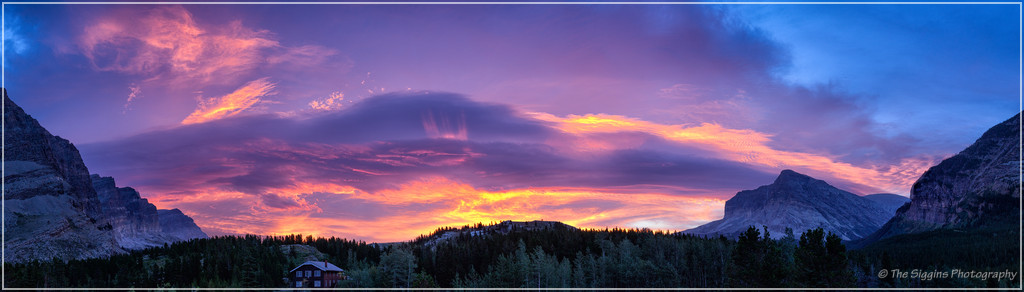
The name of the boat pretty much sums up that day in Glacier.  We had woken up to a fantastic sunrise right outside our hotel and I was given enough time to set up to take nine shots to stitch together to create this panorama.   After a big breakfast we had one of our best hikes of the trip up to Grinnell Glacier.  The best part was I was able to share it with June.


As joyful as this day was it pales in comparison to the joy of being forgiven through the sacrifice of Jesus.   The word joy occurs 217 times in the Bible and this joy is available to all.  What a blessing!  I'll leave you with Paul's words.

May the God of hope fill you with all joy and peace as you trust in him, so that you may overflow with hope by the power of the Holy Spirit. - Romans 15:13

Saturday, April 28, 2012

Appreciating My Backyard

This is what I see right now when standing in my backyard.   It looks a little different from the March 25 view I posted earlier.  The field is full of yellow buttercups.   Cattle graze here and I wondered why they didn't eat the buttercups.   I've learned that buttercups are poisonous and the acrid taste and the blistering of the mouth caused by their poison means the buttercups are left alone to grow and spread across the hills. 

I've been watching for dramatic skies at sunset but it does not happen very often and when it does it's usually gone by the time I can get out there.  I'll keep watching and trying to get out there in time.

This photo reminds me just how blessed I am.   Sometimes I focus too much on the material things and miss the blessings God has placed right in front of me.   This view is just one of those blessings.   My photography has made me appreciate God's gifts of beauty all around us.   June and I both notice that we are stopping and looking at things we would have passed right by without noticing a few years ago.   Canada Violets are pretty common around here in the spring.  They're not something that you would stop and take time to appreciate, especially in the rain.  But this one was taken last weekend in the Smokies in between rain storms.   If we hadn't taken the time to stop and been willing to risk the rain, we would have missed this wildflower decorated with jewels of rain.

What else has God placed before us?   The grand panoramas and the little jewels are all around us and say "Look what God has done here!".  A friend sent me an email this week with this verse that says it better than I can.

"God's invisible qualities and divine nature have been clearly seen in all creation, so that men are without excuse."  -  Romans 1:20

Let's slow down and appreciate God's invisible qualities and divine nature all around us.

Wednesday, June 29, 2011

Do You Feel Persecuted?

Many churches today are persecuted in one way or another for many different reasons.   The Prince William's Parish Church, or the Sheldon Church as it is known today, has seen extreme persecution in it's 266 year history.  The church is located between the towns of Beaufort and Yemassee in South Carolina.  It was built between 1745 and 1753 and funded by William Bull, who was the Lieutenant Governor of South Carolina.  Bull died before the church was even completed and was buried at the base of the altar inside the church.  His grave is there, inside the old walls.
William Bull's Grave

During the Revolutionary War, the church was set on fire when British General Augustine Prevost invaded the area in 1779.  In 1826, the church was rebuilt using the surviving walls of the original structure.  On January 14, 1865, the church was burned a second time when it was set on fire by Sherman's troops during his "March to the Sea'' campaign.   It was never rebuilt.

I have done a little internet research to try and understand why churches were burned during the wars.  One site claimed gunpowder was stored in the church during the Civil War.  Another claimed the British associated some churches with American revolutionaries.   I never did find anything definitive. 

Today the wall and front columns are still standing surrounded by beautiful Live Oaks and Dogwoods.   There are a few graves around the church dating back to the early 1700's.


Some of the oldest graves

Old Sheldon Church
We got to the church not long after sunrise to take advantage of the soft, warm early morning light.   Before the sun was high enough to shine on the church itself, the indirect light made the church ruins glow like there was a light on inside.   It was a bit hazy early in the morning, which made the skies white or grey.   I've intentionally cropped the photos to remove as much of the sky as possible.

After spending some quality time with South Carolina's finest mosquitoes, we were getting ready to leave when the sun got just high enough to shine through the tree leaves.   I took advantage of this to capture a "sun burst" above the church.   To get this effect you need to shoot with a small aperture (I used f/25 here) and position the camera so the sun is partially blocked, creating a pinpoint light source. 

I hope you enjoy these photos.  These and others are available for purchase in the Sheldon Church Gallery


Thursday, March 31, 2011

If you don't go, you'll never get the photo!

This past weekend I went with my friends in the Eastman Camera Club to Charleston SC for a long weekend of photography and friendship.   This was a great trip, even if the weather didn't cooperate.  On Sunday morning we got up way early to leave the hotel at 5:30 AM for sunrise at Folly Beach.   It started raining Saturday afternoon and had been raining ever since.   When we left the hotel it was raining pretty hard without much sign of clearing.   We kept telling ourselves, "if you don't go you'll never get the photo"   Not everyone agreed it was worth trying and only half our crew got up that morning.  

When we reached the beach it was still raining but after about 15 minutes, the rain slowed down enough to get out of the cars.  At that point about 7 of use headed down the path toward the beach with no blue sky to be seen.  About 5 minutes later we walked out on the beach, the rain stopped, and the clouds started breaking up!  Our prayers were answered -- God blew the rain out and gave us a couple hours of shooting time.

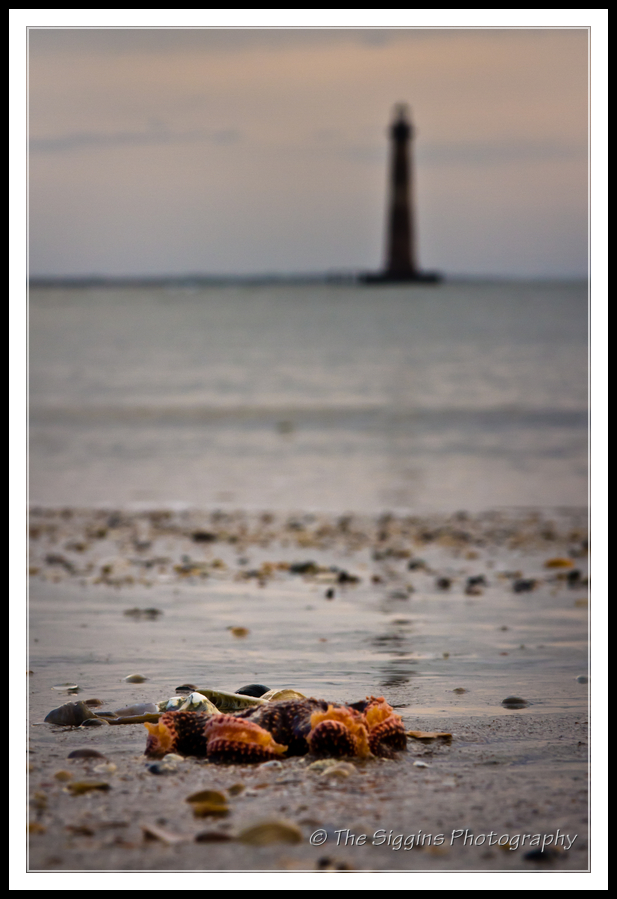
Something I never saw growing up in Florida was a starfish on the beach.   This morning we saw two live ones and one that had spent too much time in the South Carolina sun.

f/8, 1/40 sec. 70mm handheld

This one reminded me of John Travolta in Saturday Night Fever. 

f/8. 1/20, 100mm handheld
The landmark on Folly Beach is the lighthouse that is just off shore.   The skies were still dull grey and cloudy and the lighthouse was a bit dull itself, which does not make for dramatic photos.   To make things a little more interesting I got low and shot the starfish with the lighthouse in the background.   The sand was very wet and I didn't want my camera in the sand and I didn't want to lay down in the sand to make the shot.   I ended up resting the camera on my wallet to keep it off the sand.  

f/14, 1/80 sec, 95mm "Wallet Mount"
The wallet was my idea, but someone else suggested the composition. 

Finally, the sun came out enough to give us some good low side light on the dead trees along the beach and the lighthouse offshore.


f/16, 1/60, 50mm hand held
My friends came away with several good photos from Sunday morning.  If we had stayed in bed or went back to bed when it was raining, we never would have gotten any shots of Folly Beach.   Sometimes you have to get up at completely unreasonable times, drive with no promise of good light or even good weather, and pray that you will find something worthily of shooting.   There are no guarantees, expect "if you don't go, you'll never get the photo".

Friday, January 1, 2010

Wakodahatchee Wetlands December 2009


Seems like when ever we're on vacation, June and I will get up at completely unreasonable times to drive somewhere to take pictures at sunrise. Why would we do such crazy things on vacation? I do it because the golden hour just before and after sunrise is the best time for outdoor photography. The light is low making long interesting shadows. The light is also softer and has a warmer color. As long as the weather cooperates, it's the best time of the day to take photographs outside. I guess June gets up this early on vacation because she loves me :)

While visiting family in West Palm Beach, we got up early one morning to go to the Wakodahatchee Wetlands in Delray Beach, which is a great place to photograph birds. Wakodahatchee means "Created Waters" in Siminole Indian. The wetlands were created by pumping treated waste water into the wetlands. The birds naturally migrate and nest in the wetlands. We saw Great Blue Herons, Green Herons, Anhingas, Cooper's Hawks, Egrets, and many other birds. There were even a few gators lurking around. They have built a system of boardwalks that allow you to walk among the wetlands to get close up views of the wildlife.

My photos from this trip are available http://www.thesiggins.com/Earth-Sea-and-Sky-1/Florida/13630510_8hY5W#994658109_agyMd
More information about the wetlands is available at http://www.pbcgov.com/waterutilities/wakodahatchee/