Wednesday, September 23, 2015

Four Nights on Kenai Lake

Cabin on Kenai Lake

After a few days off to visit our son in Michigan, I'm back to blogging about our recent Alaska vacation.   I hope you get something out of these posts.   If you want to know more about the places we visited just drop me a note at r.siggins@charter.net

You can view the photos full size by clicking on them.
Kenai Lake

During the second half of our vacation we were blessed to be able to spend four nights on the shore of Kenai Lake at Renfros Lakeside Retreat.  With the Kenai mountains as a backdrop it was beautiful place to spend some relaxing times in the mornings and evenings. Our cabin was situated right on the lake shore with only a handful of other cabins for neighbors.   Most of the time the only sound was water lapping on the rocks and drift wood just outside.  But there were a few times with some excitement.

One day a float plane pilot was practicing takeoffs and landings on the lake just outside our door.  We sat in the chairs with hot coffee in one hand and a camera in the other.  We watched as he made several passes landing on the surface of the lake then taking off again.  It was almost as if we had our own (very) little airshow right there on the lake.


Touch and Go

A couple times we saw a Bald Eagle at the lake flying by just above the tree tops.  I didn't have my camera ready either time.  Later when I went outside to wait and watch for an Eagle, there were none in sight.   I didn't get any Eagle shots but we both have great memories for those magnificent birds flying over our heads.

Renfros Lakeside Retreat is on the main highway between Anchorage and Seward.  In fact, Seward Highway Scenic Byway is the only road between these to cities.   The Alaska Railroad also passed by on the run between Anchorage and Seward.  One day June was outside with my camera watching for the Eagle and captured the train as it passed by on the far side of the lake.

Alaska Railroad
Stars Starting To Come Out

The last day there we noticed the lake level seemed to be higher than it had been.   What had happened is a glacier that had dammed up the Snow River released and all that water that had built up behind the glacier was flowing down the Snow River into Kenai Lake.   This is a naturally occurring process.  In the headwaters of the Snow River the Snow Glacier creates a lake.  Over time precipitation and melting glacial ice cause the lake level to raise.  When the lake is sufficiently filled it causes a small part of the Glacier to lift, thus draining the lake.  It never reached flood stage but it was interesting to see the water rise so quickly.

When we made our travel plans I was excited about being able to photograph the stars out away from light pollution created by city lights.  I even rented a special lens just to take star photos while in Alaska.   I knew I was going to get spectacular shots of the Milky Way and a dark star filled sky!  The anticipation and expectations were running pretty high.

The first half of the trip in Denali National Park was cloudy and I never had a clear night.  When we were on Kenai Lake the skies were clear with only a few passing clouds.  Now's my chance for that Milky Way photo.  An hour or so after sunset I set up my camera, figured out where the Milky Way was going to appear and prepared to make some spectacular photos of the stars.

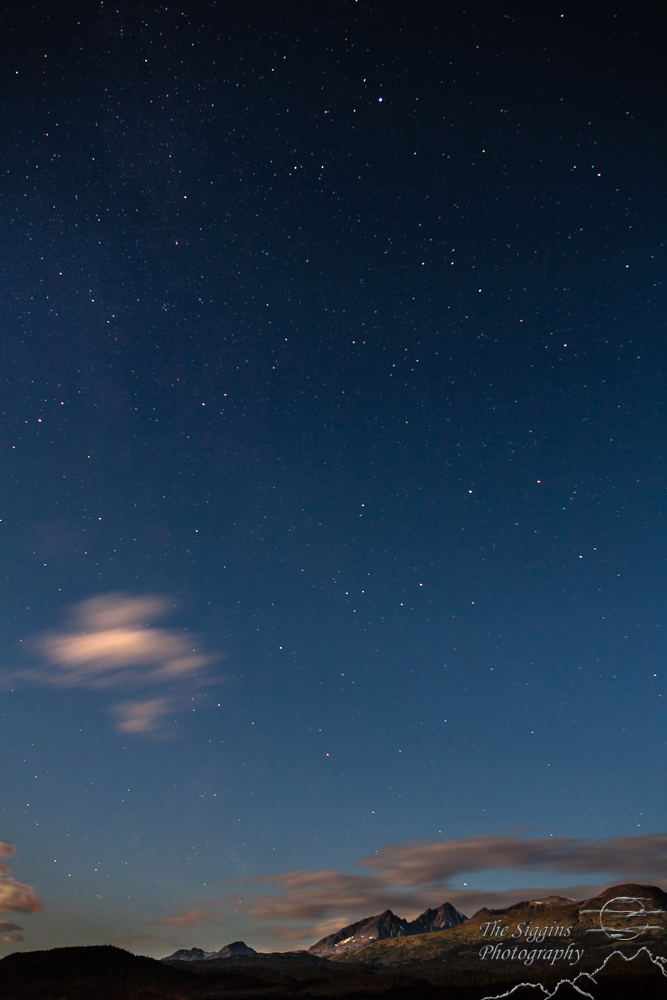
I had neglected to take the moon into account and within a short few minutes a very bright full moon popped up above the mountains and illuminated everything in sight.  All but the brightest stars became invisible in the glare of the full moon.  After a while it was bright enough to read a newspaper by moonlight.

The Moonlight Scene photo below had a 4 minute exposure time.  You can see the few bright stars became streaks of light as they traveled across the sky in those 4 minutes.   If it wasn't for the stars, this could pass for a daytime scene. It was that bright.

Moonlight Scene
Milky Way in Tennessee
I carried that lens around for almost 2 weeks and never did get the stars or Milky Way photos I dreamed of while we were in Alaska.   After I got home and the day before I had to ship the lens back I took it up to Beauty Spot on Unaka Mountain and got this shot.  I made my Milky Way photo about 30 miles from home instead of 4,268 miles and four time zones away.

The Milky Way and trying to find a Bald Eagle were just two more examples of me making plans for things I have no control over.   I'm sure God was chuckling and shaking his head saying "Here he goes again with his master plan."   I couldn't do anything about the eagles, clouds or the moon, but I got some completely unplanned photos that I'm just as excited about.

It's a good thing I'm not in charge.

Tomorrow we climb a glacier!


Monday, September 21, 2015

I've landed home and about to take off again

After a quick trip to Michigan we're home again for a while.  I'm ready to take off again blogging about our trip to Alaska.   After working the real job Tuesday I'm doing a program in Johnson City on Night Photography on Tuesday night.   I'll probably not have time to do a blog until Wednesday night.

Here's a little something to prepare to take off again.  Be sure to click the photo for a full size view.

Practicing

This pilot was practicing landing and taking off from the lake behind our cabin near Moose Pass.   You can tell the lady in the back was having a great time.


Friday, September 18, 2015

Here's Some Interesting Facts About Alaska

OK, this is another travel weekend for me and I don't have time to do a full blog post about our travels.  Instead, I'll share some of the interesting facts we learned about Alaska while we were there.

Fannie Quigley's Dinner Table
First a little story about Fannie Quigley.  Fannie  is legendary in the Kantishna mining district. She arrived in 1906, and stayed until her death in 1944, at the age of 74. She staked her share of mining claims, and mined them, and although she had never shot an animal before she arrived in Kantishna, her prowess as a hunter became known throughout the Territory of Alaska. She learned to hunt caribou, sheep and moose, and to trap fox, wolves, wolverine and lynx. She was famous for her wilderness cooking, including her famous flaky pie crusts made from rendered bear lard. She grew remarkable gardens full of vegetables and flowers on the rocky slopes above timberline.

OK, here's some interesting facts about the largest state in the Union:


  • State sport - Dog Mushing. 
  • State Nickname - The Last Frontier (no, not the Final Frontier)
  • The United States purchased Alaska from Russia in 1867 for $7.2 million, about 2 cents an acre. I bet they would like to take that deal back.
  • Alaska has more than 80 potentially active volcanoes and on average 1,000 earthquakes registering 3.5 or more on the Richter scale occur in Alaska each year. 
  • Longest Day: Barrow the sun rises on May 10th, it don't set for nearly 3 months.
  • Shortest Day: Barrow when sun sets on November 18th, Barrow residents do not see the sun again for nearly two months.  Yikes!
  • There are more than 3,000 rivers in Alaska and over 3 million lakes.
  • 17 of the highest 20 mountains in the U.S. are in Alaska. It has 19 peaks over 14,000 feet. 
  • Of the total 365 million acres of land that make up Alaska, less than one-twentieth of 1% is settled.   If you got lost your bones may never be found.
  • The largest state in the union, Alaska is one-fifth the size of the Lower 48 and spans 2,400 miles east to west and 1,420 miles north to south.  Take that Texas.

We were there for two weeks and only covered a tiny little corner of this enormous state.  I see more Alaska vacations in our future.

Thursday, September 17, 2015

Whew, time for a break

I've enjoyed reliving our Alaska trip through this blog.  I hope at least a few people have enjoyed reading it and seeing the photos.   It has been taking more time to write a daily blog than I imagined, but I'm going to continue blogging until we reach the end of the trip.

We're going to be busy for the next several days and won't have time to blog again until Wednesday next week.   I'll leave you with this image.

Taking A Break on Kenai Lake

It doesn't get any better than this!

Wednesday, September 16, 2015

It's A Travel Day - Denali to Seward Alaska

We've reached the point in our journey where we have to leave the Denali area and head south to Seward Alaska.   We're going 329 miles, including driving through Anchorage on the way to Seward.

All day we kept seeing these large helicopters and Osprey aircraft.   Sometimes one at a time and sometimes in groups.   There was a reason for all this activity.   Remember what happened in Alaska around September 1?   I'll leave the answer to a later blog post.

Once we stoppped for lunch in Sarah Palin's home town of Wasilla and negotiated traffic in Anchorage, we made our way to Turnagain (turn-again) Arm.   How did that body of water get that strange name?

Turnagain Arm  is one of two waterways that branch off Cooks Inlet.  James Cook sailed into it while searching for the Northwest Passage.  The inlet was named after Cook in 1794 by George Vancouver, who had served under Cook in 1778. Turnagain Arm was named by William Bligh of HMS Bounty fame. Bligh served as Cook's Sailing Master on his 3rd and final voyage, the aim of which was discovery of the Northwest Passage.

Turnagain Arm
Upon reaching the head of Cook Inlet, Bligh was of the opinion that both Knik Arm and Turnagain Arm were the mouths of rivers and not the opening to the Northwest Passage. Under Cook's orders Bligh organized a party to travel up Knik Arm, which quickly returned to report Knik Arm indeed led only to a river.

Afterwards a second party was dispatched up Turnagain Arm and it too returned to report only a river lay ahead. As a result of this frustration the second body of water was given the disingenuous name "Turn Again".

James Cook, William Bligh, HMS Bounty.  Wow, all that High School History is coming back to me.

Kite Surfing
It was extremely windy the day we were there and we found kite surfers out on the waterway making the most of the wind.


On the other side of Turnagain Arm is the old mining town of Hope Alaska.  "Hope City" was a mining camp, established in 1896.  Portions of the town were destroyed in the 1964 Good Friday earthquake.

Hope?
How could we resist a side trip to Hope?  In 2010 there were 192 people living in this little town.  It was an interesting place.  When we arrived a little after five the town was in the process of closing down for the day.  They couldn't seem to figure out if they wanted tourists to visit or stay away.   There were a few signs directing tourists to the historic buildings in town, but there were also signs that said you can't go here or there.   At one place there was a beautiful grass covered delta where a stream emptied into Turnagain Arm.   At the edge of the delta was a large sign that said this is a beautiful place, but a private place and the owners didn't want anyone out there.

The Seaview Cafe
Every quaint Alaska town needs a historic Cafe.  The Seaview Cafe is 119 years old.


And The Seaview BAR
And a historic bar.

We wandered around the town but didn't find much to see.   If you go, save the miles and skip the drive to Hope.

Our Cabin
After getting back on the main road and passing through the metropolis of Moose Pass (population 219) we arrived at our lodging for the next several nights.   I can highly recommend Renfros Lakeside Retreat about 20 minutes outside Seward on the Seward Highway.  The cabins are tucked away in the woods on Kenai Lake.


View from back of the cabin
Tomorrow we start our adventure in Seward

Tuesday, September 15, 2015

Denali Highway - It's Not What You Think

The Denali Highway in Alaska is not a highway in the traditional sense.  According to dictionary.com a highway is "a main road, especially one between towns or cities".  The Denali Highway is not a main road.  There are no multiple lanes with on ramps, street lamps, or painted lines on asphalt.   It is a 134-mile-long dirt road that links Paxson (population 40) to Cantwell (population 222).

Lonely Highway
When the Denali Highway opened in 1957, it was the only road to Denali National Park and Preserve until the completion of the Parks Highway in 1972. Prior to 1957, Denali national park was only accessible only by railroad.

Today few people travel the Denali Highway.  It is a direct route if any of the 40 people in Paxon want to visit the 222 in Cantwall.   Other than that, it's pretty much tourists and photographers that travel the road. The October 2010 issue of National Geographic Traveler magazine lists the Denali Highway as number 2 in their list of “roads that are pure fun to drive” highlighting “the gritty charms of a remote Alaskan highway.”

We spent a few hours one afternoon and traveled about 30 miles down the highway from Cantwell.   The scenery along the road is beautiful.   Being an unimproved road, you can pull off most anywere and not worry about traffic.
Wide Open Spaces
After the first few miles the road turns to gravel and most signs of civilization disappear.  No gas stations, fast food, power lines or buildings to obstruct the view.

We stayed here for a while
We spent 3 hours on the highway and could have spent days.   Every turn reveals new exciting view of beautiful landscapes in every direction.   We didn't turn back until it was getting dark.  I wouldn't trade any of our time in other areas of Alaska, but when we go back we will spend more time and travel the entire 134 miles.

It's Not A Secret
We stopped and spent a while at this little creek.  The grasses had turned golden, the creek was peaceful, and the clouds were blowing around the mountains in the distance.   It was the kind of place where you can stay and stay.

When we stopped at the creek there was another photographer there from Colorado doing the same thing.   We traded places along the edge of the creek stealing each other's shots.
Fireweed
Gold wasn't the only fall color.  A colorful sight in most of the places we visited, fireweed thrives in open meadows, along streams, roadsides, and forest edges. In some places, this species is so abundant that it can carpet entire meadows with brilliant pink flowers.  Even after the flowers fall the stems are brilliant red or purple with wispy parachutes that blow in the wind spreading the seeds.

The name fireweed stems from its ability to rapidly colonize areas burned by fire.

God Beams

Peaceful


Grass In Lake
Near the end of our journey down the highway we stopped at a small lake.   The sky was getting dark and the water perfectly reflected that dark sky.   I thought these clumps of grass were pretty cool.

We spotted a couple Trumpeter Swans at the far end of the lake.   The Trumpeter Swan is the largest of North American waterfowl.  It summers in Alaska before migrating down the coast to a slightly warmer client.   It is also a conservation success story, returning after being reduced to near extinction by the early 20th century.


Trumpeter Swans

We made our way down the lake getting closer and closer to the Swans.  I made more photos each time we stopped afraid that they would fly off at any moment.   They never left, gracefully swimming back and forth looking for food under the water.


It was getting dark at this point and it was difficult to make photos from a long distance in the low light.   All the Swan photos were shot with a 420mm telephoto lens on a tripod.  There was no other way to get these shots.

Show Off

We stayed as long as possible, but had to return to our cabin for one more night before heading off to Seward.   This last photo was taken just outside our cabin when we woke up the next morning.

McKinley Creekside Cabins
It had snowed overnight and the mountains were covered with a light snow.  What a beautiful way to end our time at Denali National Park.

The cabins were a neat place to stay outside Denali.   Let me know if you have questions about where we went or where we stayed on our trip.  I can tell you about some fantastic places!


Monday, September 14, 2015

Looking For The Unexpected

One of the funny things about photography is we may think we have a plan and go out to photograph one subject and discover something completely unexpected and wonderful to photograph.   This is especially true in nature photography where we have very little control over the conditions we are in.  While on vacation I have gotten up at completely unreasonable times to drive a good distance to make photos of sunrise only to find only clouds or fog.   I've gone to Cades Cove several times to photograph Black Bears and not see a single one.

"We may make our plans, but God has the last word" 

- Proverbs 16:1 (Good News Translation).

We had this happen over and over again while in Alaska.   Here's just a few.

While still at Kantishna a friend told us about an old beaver pond near the airstrip.   No one had seen a beaver there and the people at the lodge thought the beavers may have moved on a while ago.   We had a couple hours before dinner so off we went to see what we could find.

The path to the ponds was more of a magician's  illusion - turn your head and it's gone.   We had been given some good directions and eventually made our way to some pretty ponds. We didn't see a beaver but did see three ducks in a small pond behaving very strangely.  They were swimming back at forth and appeared to be agitated by something.  I don't think it was us because we were pretty far away.   We watched them for a while and noticed something else was in the pond with them.
This pond is not big enough for all of us.
Yep, there was a beaver in that little pond.  He would swim back and forth across the pond.  It looked like he was trying to chase the ducks off but the were having no part of that.   We went to the beaver ponds not expecting to find a beaver and found both ducks and a beaver.


One thing we did find that I didn't expect was grasses on a mound of mud with a dead tree that made a nice pleasing photo.   If I had said we were going to look for mud, a dead tree and a clump of grass to photography people would have thought I was crazy.   This was an unexpected treat.

On our bus ride out we spotted some more moose.

Daddy Moose
It's hard to tell what's going on in this photo.  It was hard to tell when we were looking at it from the bus.  The driver explained what we were seeing is a bull moose that is in the process of losing the velvet off his antlers.   There were shreds still hanging on and some blood stains on the bone.
Momma and Baby Moose
 The photo of Momma and Baby was another long shot.  It was raining and a bit foggy, making the photo a little too fuzzy for me.   I did some Photoshop magic and made it appear to be a watercolor painting on canvas.  Not something I typically do to my photos but in this case it made a poor photo into something interesting.

We had planned to spend another day exploring Denali by bus but the weather turned nasty.  We went for a hike along the Savage River in a blizzard!
Savage River Blizzard
Snow
When it wasn't snowing it was blowing horizontal rain.   I couldn't take the lens cap off and make a shot before the lens was peppered with snowflakes.   It didn't look good for exploring or photographing that day.

One the way back to the park entrance we pulled over and started making photos of an area with a lot of Aspen trees with golden leafs.  While we were there the unexpected happened.   The clouds started to break and the sun beamed down on the Aspens and evergreens.   Then a rainbow appeared!


Rainbow

There's gold in them there hills!
OK, you're looking at these photos and thinking "he edited those to make the colors more vibrant."   This is what it looked like!   I told June while we were there that no one would believe how beautiful it was.

Before too long we had lots of company with cameras along the side of the road making photos of the unexpected beauty on a miserable cloudy, rainy, snowy day.

We were blessed that day with even more beautiful scenes.  God had the last word.

Tomorrow's blog will be about our afternoon on the Denali Highway - a 135 mile long dirt road through some of the most beautiful scenery outside the National Park.